What Makes a Startup Landing Page Actually Convert?
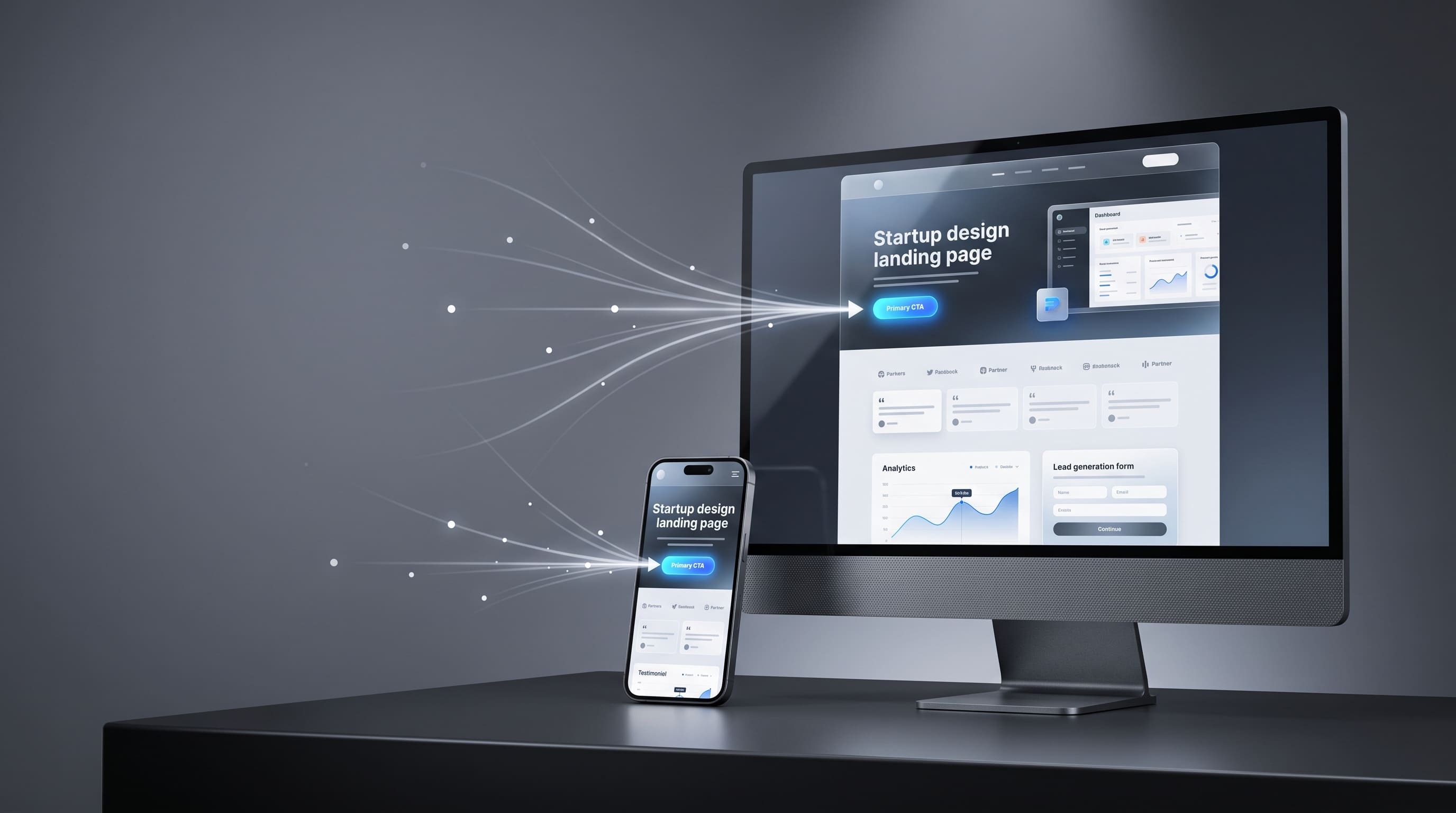
A beautiful website isn't enough. Your landing page needs to make people take action.
A startup can have a great product, a strong team, and a solid marketing campaign.
Then the traffic reaches the website.
And nothing happens.
Visitors leave.
No demo bookings.
No signups.
No enquiries.
No sales.
The problem isn't always the traffic.
Sometimes the landing page is simply asking visitors to work too hard to understand why they should care.
A high-converting startup landing page has one job:
Move the right visitor toward one clear action.
That action could be booking a demo, requesting a quote, starting a trial, joining a waitlist, or contacting the business.
Everything on the page should support that goal.
What is a startup landing page?
A startup landing page is a focused website page designed around a specific product, service, campaign, or business objective.
Unlike a traditional company website that may have dozens of pages, a landing page usually has a much narrower purpose.
For example:
Paid Advertisement
       ↓
Landing Page
       ↓
Clear Offer
       ↓
Trust
       ↓
Call to Action
       ↓
Lead / Demo / Sale
The fewer distractions between the visitor and the desired action, the better.
1. Your headline needs to explain the value immediately
One of the biggest mistakes on startup websites is writing headlines that sound impressive but don't explain anything.
For example:
"Reimagining the Future of Business."
It sounds polished.
But what does the company actually do?
Compare it with:
"Automate your customer support with an AI receptionist that answers calls 24/7."
The second headline immediately communicates:
What it is
What it does
Who it helps
Why it matters
Your visitor shouldn't have to scroll to understand your offer.
2. Sell the outcome, not the feature
Your customer doesn't necessarily care that your product has:
AI
APIs
dashboards
automation
cloud infrastructure
advanced analytics
They care about the result.
Instead of:
"AI-powered CRM automation platform."
Consider:
"Follow up with every lead automatically and stop losing prospects because your team forgot to respond."
The feature is still there.
But now it's connected to a business outcome.
3. Give the visitor one primary CTA
A landing page shouldn't feel like a maze.
If your main objective is generating sales calls, your primary CTA might be:
Book a Strategy Call
If you're launching a SaaS product:
Start Free Trial
If you're collecting early users:
Join the Waitlist
If you're selling a service:
Get a Free Quote
You can have secondary links, but one action should clearly dominate the page.
4. Your landing page needs a strong visual hierarchy
Visitors don't read websites the same way they read documents.
They scan.
That's why the page needs a visual hierarchy that makes the important information obvious.
A typical structure might look like:
                    HERO
                     ↓
             Value Proposition
                     ↓
                  CTA
                     ↓
              Social Proof
                     ↓
             Problem / Pain
                     ↓
                 Solution
                     ↓
              Benefits
                     ↓
             How It Works
                     ↓
            Testimonials
                     ↓
                 FAQ
                     ↓
                  CTA
The visitor should always know:
Where am I?
What does this company offer?
Why should I trust it?
What should I do next?
5. Social proof reduces uncertainty
People are naturally cautious about buying something unfamiliar.
Especially from a startup.
That's why social proof matters.
Depending on your business, this could include:
Customer testimonials
Client logos
Case studies
Reviews
Usage numbers
Results
Certifications
Media mentions
Product screenshots
But don't add fake-looking testimonials just to fill space.
Specific proof is much stronger.
Instead of:
"Amazing service!"
Use something that explains the actual outcome:
"We launched our campaign page in three days and started receiving qualified enquiries from the first week."
Specificity creates credibility.
6. Show the product instead of only describing it
If you're selling software, don't make visitors imagine what they're buying.
Show them.
Use:
Product screenshots
Dashboard previews
Before-and-after examples
Short product videos
Interactive demonstrations
Real UI
For service businesses, show the actual work.
Your portfolio should answer:
"Can these people actually do what they're promising?"
7. Speed matters
A beautiful landing page that takes too long to load is still a bad landing page.
Especially when traffic is coming from mobile devices or paid advertising.
That's why the technology underneath the page matters.
At Cohexify, we build landing pages using modern technologies such as Next.js, React and TypeScript rather than relying on heavy, bloated templates. This allows us to focus on performance, responsive design, technical SEO and conversion together.
The objective isn't to use technology because it sounds impressive.
The objective is simple:
Make the experience fast.
8. Mobile design isn't optional
A landing page should not be designed for desktop and "made responsive" afterward.
The mobile experience needs to be considered from the beginning.
Check:
Headline length
Button size
Navigation
Form fields
Image sizes
Spacing
Text readability
Page speed
Sticky CTAs
A visitor should be able to understand the offer and take action comfortably from a phone.
9. SEO should be built into the page
A landing page shouldn't only look good.
Search engines need to understand it too.
Important SEO fundamentals include:
Search-focused page title
Meta description
Proper heading structure
Semantic HTML
Descriptive URLs
Optimized images
Internal links
Structured data where appropriate
Mobile performance
Fast loading times
Crawlable content
But SEO shouldn't destroy the user experience.
Don't write paragraphs full of keywords just because you want to rank for "best startup landing page."
Write for humans first.
Structure it so search engines can understand it naturally.
10. Your landing page and your advertising need to match
Imagine your advertisement says:
"Launch your startup website in 3 days."
The visitor clicks.
Then the landing page headline says:
"We build beautiful digital experiences."
There's a disconnect.
The visitor expected one thing and landed somewhere else.
Instead:
AD
"Launch your startup website in 3 days."

          ↓

LANDING PAGE
"Startup websites designed and launched in 3 days."

          ↓

CTA
"Start Your Project"
The message stays consistent.
This is called message match, and it can make a major difference to the quality of the visitor experience.
11. Remove unnecessary friction
Every additional step creates an opportunity for someone to leave.
Ask yourself:
Do they really need to create an account before requesting information?
Do you really need 15 form fields?
Does the visitor need to read three paragraphs before seeing the CTA?
Does the navigation need seven options?
Does the page need every feature your product has ever shipped?
Probably not.
A good landing page removes friction wherever possible.
12. Your website should support your sales process
A landing page shouldn't exist in isolation.
The lead needs to go somewhere.
For example:
Visitor
   ↓
Landing Page
   ↓
Lead Form
   ↓
Email / CRM
   ↓
Sales Team
   ↓
Discovery Call
   ↓
Customer
This is where integrations become valuable.
Depending on the business, your landing page can connect with:
CRM systems
Email platforms
Calendars
Analytics
Payment systems
Marketing automation
WhatsApp
Lead management systems
The website becomes part of the sales process instead of being a digital brochure.
How long should a startup landing page take to build?
It depends on the project.
But a simple, focused landing page shouldn't automatically take weeks or months.
At Cohexify, our process is designed around rapid execution:
Day 1: Strategy & Copy
We define:
Target audience
Offer
Positioning
Conversion goal
Page structure
Core messaging
Day 2: Design & Development
We create the visual design and turn it into a responsive production website.
Day 3: Launch
We complete:
QA
Mobile optimization
SEO setup
Forms
Analytics
Integrations
Deployment
Our current service is specifically designed around launching conversion-focused landing pages and portfolio websites in roughly 2-3 days, depending on scope.
What should a startup landing page cost?
There isn't one universal price.
The cost depends on:
Number of sections
Copywriting requirements
Custom design
Animations
Integrations
CMS requirements
Forms
CRM integration
SEO requirements
Custom functionality
A simple marketing landing page is very different from a complex product website connected to a CRM and analytics stack.
The important question isn't:
"How cheap can I get a website?"
It's:
"How much is a visitor worth to my business?"
If your landing page generates qualified leads, the website is an acquisition asset.
That's how it should be treated.
The landing page conversion checklist
Before launching, ask:
Messaging
Is the offer immediately clear?
Does the headline communicate a benefit?
Is the target audience obvious?
Is the copy focused on outcomes?
Design
Is the visual hierarchy clear?
Does the page look credible?
Are CTAs obvious?
Is the design consistent with the brand?
Conversion
Is there one primary CTA?
Is the form simple?
Is there enough trust?
Are objections answered?
Performance
Does it load quickly?
Is it optimized for mobile?
Are images optimized?
Is unnecessary JavaScript removed?
SEO
Is the page indexable?
Is the title optimized?
Is the meta description present?
Are headings structured correctly?
Are images accessible?
Tracking
Are conversions tracked?
Is analytics installed?
Are forms connected to the right destination?
Can you measure where leads come from?
A landing page should be an investment, not decoration
Your website is often the first interaction a potential customer has with your business.
If the visitor doesn't understand your offer, doesn't trust you, or can't figure out what to do next, you're losing opportunities before your sales team ever gets involved.
A high-converting landing page combines:
Strategy + Copy + Design + Performance + SEO + Conversion
Not just pretty visuals.
At Cohexify, we design, develop and launch conversion-focused landing pages and premium portfolio websites for startups and businesses that need to turn traffic into enquiries, bookings and customers.
If you're planning a startup launch, running paid ads, redesigning an outdated website, or simply not getting enough leads from your current site, the landing page may be the first thing worth fixing.
Stop sending traffic to a website that doesn't convert. Build a page that gives that traffic somewhere to go.